
Introduction
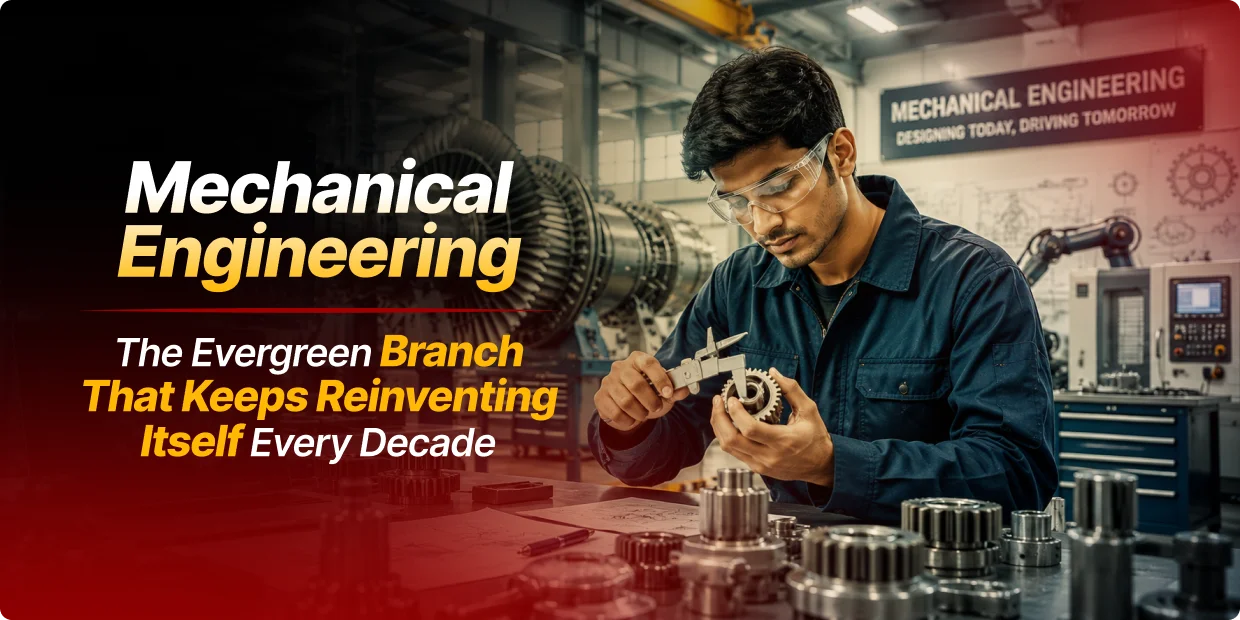
Mechanical engineering is the broadest and most versatile of all engineering disciplines, encompassing the design, analysis, manufacturing, and maintenance of mechanical systems. , mechanical engineers work across virtually every industry, from aerospace and automotive to energy, robotics, biomedical devices, and consumer products. The field combines core principles of mechanics, thermodynamics, materials science, and manufacturing with emerging technologies like additive manufacturing, AI-driven design, and advanced simulation.
Often called the mother of all engineering branches, mechanical engineering provides a foundation so broad that graduates can adapt to almost any technical career, making it one of the safest and most rewarding engineering choices.
What Is Mechanical Engineering?
Mechanical Engineering is an engineering discipline that focuses on thermal systems, manufacturing, CAD/CAM, robotics, energy systems. The field combines theoretical knowledge with practical application to solve complex challenges across industries. Core subjects include fundamental sciences, specialized technical courses, laboratory work, and design projects that prepare students for professional practice.
Professionals in this field use advanced tools, software, and methodologies to design, analyze, test, and optimize systems and processes. The interdisciplinary nature of modern mechanical engineering means practitioners often collaborate with experts from other engineering and science disciplines.
Educational Pathway and Top Colleges
Students typically pursue a B.Tech or B.E. degree in Mechanical Engineering after qualifying entrance exams such as JEE Main, JEE Advanced, BITSAT, or state-level engineering entrance tests. India offers programs at various IITs, NITs, and premier private institutions. Internationally, top universities in the US, UK, Germany, and Singapore offer excellent programs.
Postgraduate studies (M.Tech, MS, or PhD) allow specialization in sub-domains of mechanical engineering, significantly enhancing research capabilities and career prospects. Many professionals also pursue industry certifications and continuing education to stay current with evolving technologies.
Career Opportunities and Job Roles
Graduates in mechanical engineering find employment across diverse sectors including manufacturing, technology, consulting, research, and government organizations. Both multinational corporations and innovative startups actively recruit professionals with expertise in thermal systems, manufacturing, CAD/CAM, robotics, energy systems.
Common job roles include design engineer, research scientist, project manager, quality assurance specialist, technical consultant, and product development engineer. With experience, professionals advance to senior technical or management positions, and many also pursue entrepreneurial ventures leveraging their domain expertise.
Salary Trends
Entry-level professionals in mechanical engineering in India can expect starting salaries ranging from INR 4 to 8 lakhs per annum, depending on the employer, location, and individual skills. Mid-career professionals with specialized expertise earn INR 12 to 25 lakhs, while senior engineers and managers at leading companies earn significantly more.
Globally, particularly in the US, Europe, and the Middle East, salaries are substantially higher, reflecting the high demand for skilled engineers. The salary trajectory in this field rewards continuous learning and specialization.
Emerging Trends and Future Scope
The field of mechanical engineering is being transformed by emerging technologies including artificial intelligence, automation, sustainable design practices, and digital simulation tools. Industry 4.0 concepts are being integrated into traditional practices, creating new opportunities for innovation and efficiency improvement.
Professionals who combine domain expertise in mechanical engineering with skills in data analytics, programming, and emerging technologies will be best positioned for the future. The growing emphasis on sustainability and green engineering practices is also creating new career pathways and research opportunities in this field.
Conclusion
Mechanical Engineering offers a compelling combination of intellectual challenge, practical impact, and career stability. As technology continues to evolve and industries face new challenges, the demand for skilled professionals in this field will only grow. For students and professionals who are passionate about innovation and problem-solving, mechanical engineering provides a rewarding career path with diverse opportunities and the potential to make a meaningful contribution to society and industry.
