
Introduction
Ceramic engineering is a specialized branch of materials science that deals with the creation, design, and manufacture of ceramic materials, including advanced technical ceramics, refractories, glass, cement, and abrasives. While often overlooked in favor of more prominent engineering disciplines, ceramic engineering is the invisible backbone of numerous high-tech industries, from semiconductor manufacturing and aerospace to biomedical implants and energy storage.
With the growing demand for heat-resistant, lightweight, and biocompatible materials, ceramic engineering is experiencing a renaissance. Advanced ceramics are critical components in everything from jet engine turbine blades to artificial hip joints, making this field essential for modern technological progress.
What Is Ceramic Engineering?
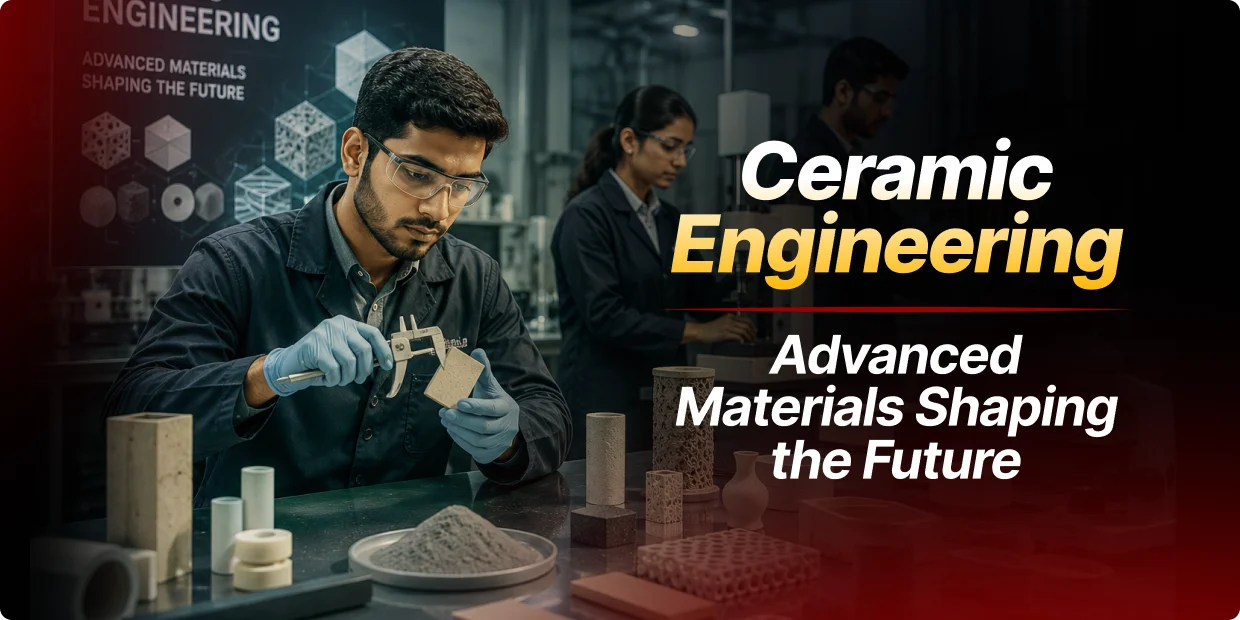
Ceramic engineering focuses on the science and technology of inorganic, non-metallic materials processed at high temperatures. These materials include traditional ceramics (pottery, bricks, tiles) and advanced ceramics (silicon carbide, alumina, zirconia, piezoelectrics, and bioceramics). The field covers material synthesis, processing, characterization, and application development.
Ceramic engineers study crystal structures, phase diagrams, sintering processes, and the relationship between microstructure and material properties such as hardness, thermal resistance, electrical conductivity, and biocompatibility.
Educational Pathway and Top Colleges
B.Tech programs in Ceramic Engineering or Ceramic Technology are offered by select institutions. In India, IIT (BHU) Varanasi, Government College of Engineering and Ceramic Technology Kolkata, NIT Rourkela, and Anna University are prominent. Internationally, Alfred University (USA), University of Sheffield (UK), and Aachen University (Germany) are leaders in ceramic research.
Students typically study chemistry, physics, materials science, thermodynamics, and specialized courses in ceramic processing, glass science, and refractories.
Career Opportunities
Ceramic engineers work in glass manufacturing, cement and construction materials, semiconductor fabrication, aerospace components, biomedical devices, and energy industries. Companies like Saint-Gobain, Corning, CoorsTek, Kyocera, and 3M actively recruit ceramic engineers.
Job roles include ceramic process engineer, quality control specialist, materials researcher, refractories engineer, and applications engineer. The biomedical sector offers roles in developing ceramic implants and coatings for orthopedic and dental applications.
Salary Trends
Entry-level ceramic engineers in India earn INR 3.5 to 6 lakhs per annum. Experienced professionals in specialized sectors like aerospace ceramics or semiconductor manufacturing earn INR 10 to 20 lakhs. In the US, ceramic engineers earn between USD 70,000 and 100,000, with senior researchers and managers earning more.
Emerging Trends
Advanced ceramic matrix composites are being used in next-generation jet engines for superior thermal performance. Bioceramics for bone regeneration and dental implants are advancing rapidly. Ceramic solid-state electrolytes are crucial for next-generation lithium batteries. Additive manufacturing of ceramics enables complex geometries previously impossible to produce. Transparent ceramics for armor and optical applications are another exciting frontier.
Conclusion
Ceramic Engineering offers a compelling combination of intellectual challenge, practical impact, and career stability. As technology continues to evolve and industries face new challenges, the demand for skilled professionals in this field will only grow. For students and professionals who are passionate about innovation and problem-solving, ceramic engineering provides a rewarding career path with diverse opportunities and the potential to make a meaningful contribution to society and industry.
