
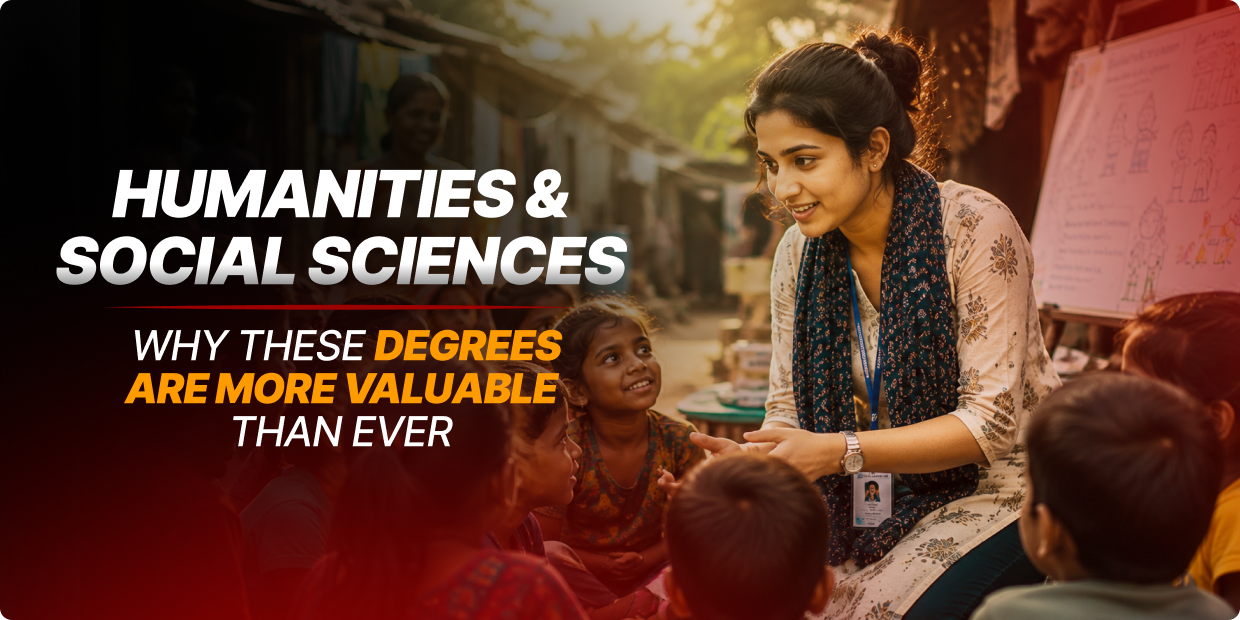
Humanities Degrees Are Useless? Tell That to the CEOs, Policymakers, and Tech Leaders Who Hold Them
Introduction
In an era obsessed with STEM degrees and coding bootcamps, humanities and social sciences quietly underpin everything that makes civilization function: governance, education, media, diplomacy, social justice, cultural preservation, mental health, and the ethical frameworks that guide technological development. , as artificial intelligence automates routine cognitive tasks and the world grapples with complex social challenges including misinformation, mental health crises, climate justice, and cultural polarization, the critical thinking, communication, empathy, and ethical reasoning that humanities and social sciences cultivate are not just relevant but essential.
The B.A. (Bachelor of Arts), B.Sc. in Social Sciences, and B.S.W. (Bachelor of Social Work) programs offer structured pathways to careers in education, public policy, journalism, psychology, social work, international relations, public administration, law, development studies, and increasingly, the technology sector where human-centered design and ethical AI require humanities expertise.
Understanding the Degree Options
The B.A. degree encompasses a vast range of disciplines including English Literature, History, Political Science, Economics, Psychology, Sociology, Philosophy, Geography, and Languages. Students can pursue honours in a single subject or study multiple subjects in a general program. The B.Sc. in Humanities and Social Sciences, offered by some universities, combines social science disciplines with quantitative research methodologies, statistics, and data analysis skills.
The B.S.W. (Bachelor of Social Work) is a professional degree specifically designed to prepare students for careers in social welfare, community development, counseling, rehabilitation, and human rights advocacy. BSW programs include extensive fieldwork components, requiring students to work with communities, NGOs, government agencies, and healthcare facilities as part of their education.
Many top universities now offer interdisciplinary programs that combine humanities with technology, data science, or business, recognizing that the most impactful professionals often work at the intersection of disciplines.
Top Colleges and Admission
India offers excellent humanities and social science programs at both prestigious universities and liberal arts colleges. Top options include Delhi University (Hindu College, St. Stephen’s, Miranda House, Lady Shri Ram), Jawaharlal Nehru University (JNU), Jadavpur University, Presidency University (Kolkata), Christ University (Bangalore), Loyola College (Chennai), Ashoka University, FLAME University, Azim Premji University, and Tata Institute of Social Sciences (TISS, for BSW and MSW).
Admission to Delhi University is through CUET scores, while JNU, TISS, and other institutions conduct their own entrance examinations. Liberal arts universities like Ashoka, Krea, and FLAME use a holistic admissions process considering academic performance, essays, and interviews. Internationally, Oxford, Cambridge, Harvard, and Yale remain the gold standard for humanities education.
Career Opportunities
Humanities graduates pursue remarkably diverse careers. Civil services (IAS, IFS, IPS) are a natural path, with many UPSC toppers holding humanities degrees. Journalism and media employ writers, editors, broadcast journalists, digital content strategists, and documentary filmmakers. The education sector hires teachers, professors, curriculum designers, and education policy analysts.
Publishing, advertising, public relations, and corporate communications actively recruit humanities graduates for their writing, critical thinking, and cultural literacy skills. The development sector including NGOs, international organizations (UN agencies, World Bank), and social enterprises employs research analysts, program managers, and advocacy specialists.
BSW graduates work as clinical social workers, community organizers, rehabilitation counselors, child welfare specialists, and mental health support professionals. Psychology graduates pursue clinical practice, organizational psychology, UX research, and market research. Political science graduates enter public policy, political consulting, and international relations.
Increasingly, technology companies hire humanities graduates for roles in content strategy, user experience research, ethics and compliance, policy advisory, and AI safety — recognizing that understanding human behavior and societal implications is crucial for responsible innovation.
Salary Trends
Starting salaries for humanities graduates vary significantly by field and institution. Entry-level salaries range from INR 2.5 to 6 lakhs per annum, with graduates from premier institutions and those entering corporate roles at the higher end. Media professionals start at INR 3 to 6 lakhs, growing to INR 10 to 25 lakhs at mid-career. Civil services officers earn INR 7 to 12 lakhs initially (plus extensive benefits), with senior positions commanding substantial compensation and influence.
BSW graduates in NGO and government roles start at INR 2.5 to 4 lakhs, while clinical social workers and counselors with master’s degrees earn INR 5 to 15 lakhs. Policy researchers at think tanks and international organizations earn INR 8 to 20 lakhs. Corporate communications and consulting roles offer INR 8 to 25 lakhs for experienced professionals.
The salary narrative for humanities is a marathon, not a sprint. While starting salaries may lag behind engineering or MBA graduates, mid-career earnings for successful humanities professionals are highly competitive, and the career satisfaction rates are consistently among the highest across all fields.
Emerging Opportunities
The intersection of humanities and technology is creating exciting new career categories. AI ethics specialists ensure artificial intelligence systems are fair, transparent, and accountable. Digital humanities researchers use computational tools to analyze cultural artifacts, historical texts, and social patterns. Content strategy for AI products requires understanding both technology capabilities and human communication needs.
Social entrepreneurship is thriving, with humanities graduates building organizations that address education inequality, healthcare access, environmental justice, and community development. The growing mental health awareness in India is creating unprecedented demand for counselors, psychologists, and social workers. ESG consulting requires professionals who understand both corporate governance and social impact measurement.
Conclusion
Humanities and social sciences degrees are not the career dead-ends that popular culture sometimes suggests. They are rigorous programs that develop critical thinking, communication, empathy, ethical reasoning, and cultural intelligence — skills that are not only resilient to automation but are increasingly valued in a complex, interconnected world. For students driven by curiosity about human experience, social justice, creative expression, or the desire to understand and improve the world, these degrees offer deeply fulfilling career pathways with growing relevance and opportunity.
